Why Doesn’t ChatGPT Show My Content? The Secret Formula to Rank Your Website in AI Search
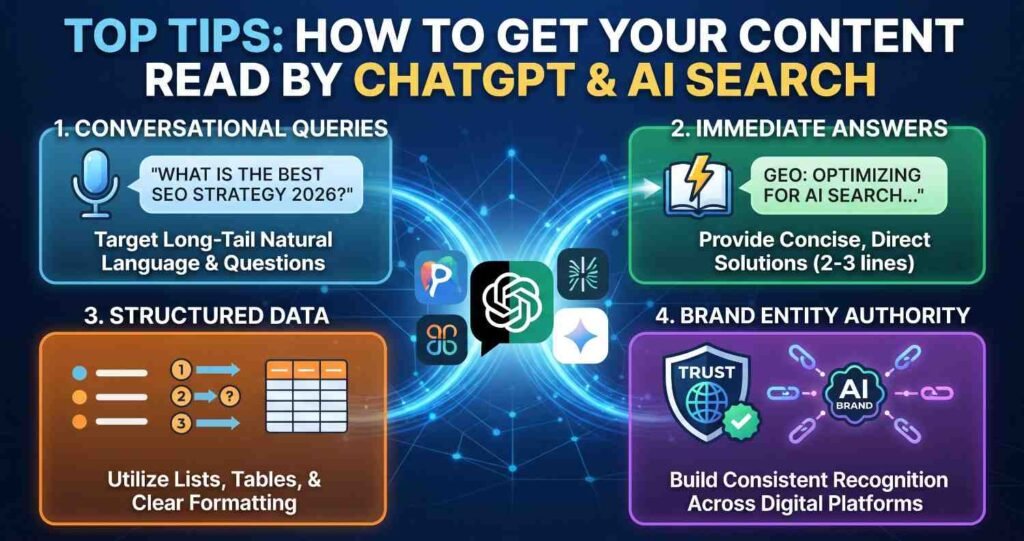
Answer:
AI search engines like ChatGPT and Perplexity do not rank websites through traditional keyword matching; instead, they synthesize direct, conversational answers from trusted digital entities. To force AI models to read, cite, and feature your content, you must abandon standard keyword stuffing and adopt Generative Engine Optimization (GEO) Guide by structuring your data for machine extraction.
Main Points
-
Conversational Query Matching: Target long-tail, natural phrasing that mimics how users actually talk to AI assistants rather than short, robotic search terms.
-
Immediate Answer Formatting: Place a concise, direct 2-to-3-line summary immediately beneath every major heading so language models can instantly extract the core solution.
-
Structured Data & Bullet Points: Utilize clean lists, tables, and hierarchical markup to make your page completely frictionless for AI crawlers to parse.
-
Entity Authority & Cross-Platform Footprint: Build widespread digital recognition across multiple channels so AI models verify your brand as a primary industry source.
Key Takeaways for AI Visibility
| Traditional SEO Approach | AI & ChatGPT Search Approach |
|---|---|
| Chasing high-volume single keywords | Answering complete conversational questions |
| Burying conclusions at the bottom of long articles | Delivering immediate, punchy answers at the top |
| Relying solely on backlinks and domain age | Establishing brand entity authority and structured data |
Top Tips to Get Your Content Read by ChatGPT & AI Search
Traditional search engine optimization taught us to target a keyword, pack it into our title tags, build backlinks, and wait for Google to index our blue links. But modern search behavior has completely flipped. When a user opens ChatGPT, Perplexity, or Gemini, they are not looking through ten pages of website links—they expect a synthesized, authoritative, single-answer response.
If your website architecture is built only for traditional crawlers, AI models will completely bypass your brand. To capture traffic from generative search engines, you need a brand-new content framework.
1. Shift from Keywords to Conversational Intent
People type keywords into Google, but they converse with AI. On Google, a user might type
seo strategy. On ChatGPT, they type: “What is the best step-by-step SEO strategy for a digital marketing agency in 2026?”
-
The Execution: Build your subheadings around real human questions. When an AI tool crawls your page, matching the user’s exact phrasing in your
H2orH3tags signals that your content holds the exact context the user is looking for.
2. Master the Immediate Answer Architecture
Large Language Models prioritize efficiency. When parsing a page, they scan for the most concise, direct explanation of a concept to summarize for the user. If your paragraphs are filled with fluff and introductory filler, the AI will ignore your page.
-
The Execution: Directly below every major subheading, write a 2-to-3-line definitive answer. Treat this mini-summary like an extraction target—clean, factual, and straight to the point.
3. Exploit Clean Structural Formatting
AI crawlers love predictable patterns. Dense walls of text force language models to work harder to extract meaning, lowering the chances that your text will be chosen for a citation.
-
The Execution: Break down complex processes using numbered sequences, bullet points, and comparative data tables. Structured elements act like neon signs for AI scrapers, making it effortless for the algorithm to lift your bullet points directly into its output.
4. Build Undeniable Brand Entity Recognition
AI models do not just read your single webpage; they cross-reference your brand across the entire internet. They check whether your name, business, and topics appear consistently across podcasts, social media platforms, guest posts, and industry directories.
-
The Execution: Keep your author bios, brand messaging, and expertise uniform across every digital channel you manage. When an AI model cross-checks your digital footprint and sees you everywhere as a recognized authority, it gains the trust required to cite your content to millions of users.
Frequently Asked Questions (FAQ)
Q1: What is Generative Engine Optimization (GEO), and how does it differ from traditional SEO?
-
Answer: Generative Engine Optimization (GEO) is the practice of structuring your website data so that AI models like ChatGPT, Perplexity, and Gemini can easily read, extract, and cite your content. Unlike traditional SEO—which focuses on short keywords, blue links, and backlink volume—GEO focuses on conversational query matching, immediate answer summaries, and brand entity authority.
Q2: Why should I place short summaries directly beneath my headings?
-
Answer: Large Language Models (LLMs) prioritize efficiency and scan pages for concise, direct explanations. Placing a 2-to-3-line summary immediately beneath every major heading acts as an “extraction target,” making it effortless for AI crawlers to pull your core solutions into their synthesized responses.
Q3: How can I build brand entity recognition for AI search engines?
-
Answer: AI models cross-reference your brand across the entire internet to verify your authority. To build undeniable recognition, keep your author bios, messaging, and expertise uniform across social media, podcasts, guest posts, and industry directories so AI scrapers trust your brand as a primary source.
About the Author
Muhammad Amjad Butt is a seasoned SEO specialist and digital marketing expert with over 23 years of hands-on practical experience in the industry. As the driving force behind pboutreach (a premier guest posting and link-building marketplace) and Pak SEO Training, he specializes in advanced search engine optimization, client acquisition, and modern content frameworks tailored for search visibility.