How to Find Link Building Clients in the US (3 Methods)
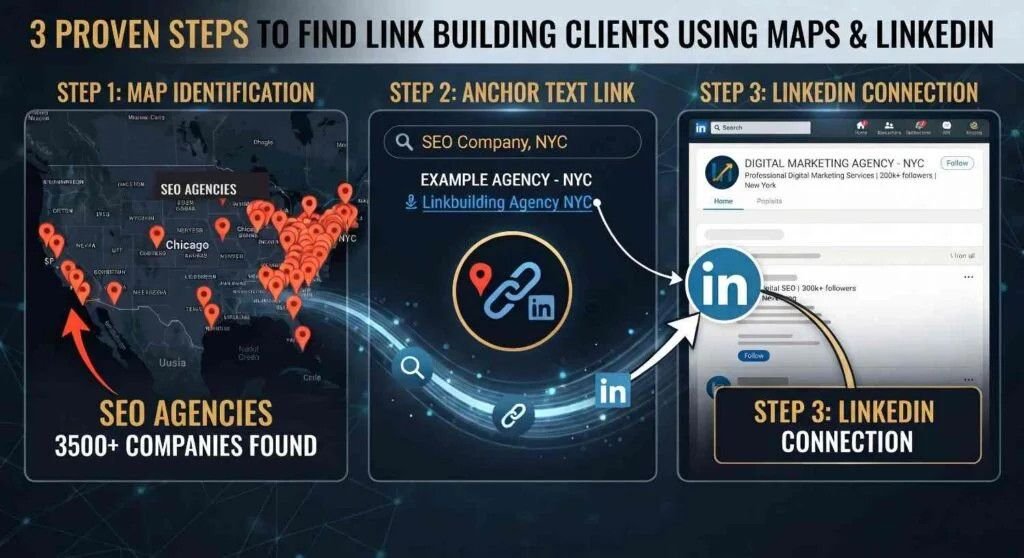
To find link building clients in the USA, copy the anchor text from a guest post that a client already paid for, then search Google with the formula “need + services + anchor text + USA”. Repeat the same anchor text on Google Maps and LinkedIn. Businesses that already buy backlinks for a keyword are your warmest leads, because they have proven they spend money on SEO.
If you sell guest posts or backlinks, you already know the hardest part is not building links. It is finding people who will pay for them. Most sellers send hundreds of cold emails to random businesses and get almost no replies. There is a smarter way to find link building clients in the USA: use the anchor text that real buyers have already paid for. When a company pays for a link on a keyword, it is telling you exactly what it wants to rank for. This guide shows you how to turn that one piece of data into a steady list of US leads using Google, Google Maps and LinkedIn, with a worked example for each method.
Why Anchor Text Is the Best Client Signal
Anchor text is the clickable text of a link. For example, in a guest post that says “join pak seo training to learn SEO”, the words “pak seo training” are the anchor text. Buyers choose anchor text carefully because it matches the keyword they want to rank for.
That makes anchor text a very strong buying signal:
- It proves budget. Someone already spent money on a link for this keyword.
- It shows the niche. You know exactly which industry the buyer is in.
- It reveals competitors. Other businesses targeting the same keyword face the same ranking problem, so they need the same service.
Key insight: A business that pays for one link on a keyword is the best clue to many more businesses that need links on that same keyword.
What does “using their own anchor text” mean?
It means you take the keyword one client is targeting and use it as a search term to find other businesses chasing the same keyword in the same country. You are not copying the client. You are using their keyword as a map to similar buyers.
Collecting Anchor Text From Existing Guest Posts
Your first job is to build a list of anchor texts. You can collect them from any admin’s website that publishes guest posts.
Where do you find client guest posts?
- Open any guest posting website, or any site in your niche that accepts sponsored posts.
- Browse its latest articles, especially those in “guest post”, “sponsored” or “contributor” categories.
- Find the outbound link inside each post that points to a business website. That is the client link.
- Copy the anchor text (the keyword the link is added on) and the domain it points to into a spreadsheet.
Aim to collect at least 20 anchor texts before you start searching. That gives you enough keywords to run all three methods for a full week.
Example: You open a guest posting website and find a client post where the link is added on the keyword “pak seo training”. You copy “pak seo training” and the client’s domain into your sheet. This one keyword is the starting point for all three methods below.
Key insight: Service and training keywords are the most valuable, because businesses that sell services depend on Google rankings and keep paying for SEO month after month. Skip generic anchors like “click here” or “read more”, because they do not reveal a niche.
Method 1: The Google Search Formula
This is the fastest way to turn an anchor text into a list of client websites. Type this formula into Google:
need + services + keyword + Country
Replace keyword with the client’s anchor text, and replace Country with USA.
Example: Using the formula with “pak seo training”
Client anchor text: pak seo training
Formula: need + services + keyword + Country
Client Finder Formula Generator
Enter your client's anchor text and choose a country. You can also add a city or state. Your Google search formula will be ready to copy and paste.
- Open a guest post and copy the client's anchor text (the keyword the link is added on).
- Paste it in the keyword box and select the country.
- If you want leads from one city or state, select or type it in the city box. Leave it empty to search the whole country.
- Copy the formula and paste it into Google.
- Open the websites one by one and collect their email IDs.
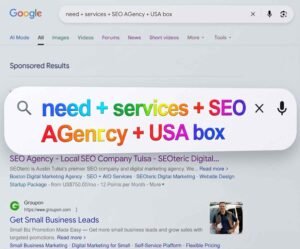
Search to type in Google: need + services + pak seo training + USA
What you get: the websites that appear in the results are your potential clients. Open them one by one and collect their email IDs.
How do you work through the search results?
- Run the search and open the websites one by one.
- Skip directories, news sites and large brands. Focus on small and mid-size business websites.
- Find the email ID on the Contact, About or footer section of each site.
- Add the website, email and anchor text to your spreadsheet.
- Compose a short email and send it (see the outreach section below).
- Repeat with the next anchor text.
A realistic target is 5 to 10 qualified websites per anchor text. With 20 anchor texts, that is 100 to 200 leads from this method in a week.
Tip: Small businesses with an email ID on their site are easier to reach and faster to close than big brands with marketing departments.
Method 2: Google Maps Activity Check
Google Maps helps you find US businesses and, more importantly, check whether they are active. Type the client’s anchor text plus the country into Google Maps:
anchor text + in + USA
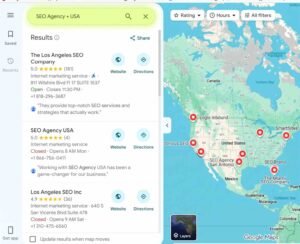
Example: Searching “Pak SEO Training in USA” on Google Maps
Search: Pak SEO Training in USA
Listing A: 48 reviews, owner replied to most of them this month. Keep it.
Listing B: 2,300 reviews, large brand. Skip it, it likely has an agency already.
Listing C: 15 reviews, no owner replies in over a year. Skip it, the business looks inactive.
Which businesses should you pick from Google Maps?
Check two things on every listing that opens:
- First, fewer than 100 reviews. Businesses with under 100 reviews are usually still growing and are more open to SEO help. Big players with thousands of reviews often have an agency already.
- Second, the owner replies to reviews. Open the reviews and check whether the business owner replies to customers. If they do, the client is active.
Google itself encourages this behavior. Its Business Profile help center says that when owners reply to customer reviews, they show customers they value their feedback. A business that follows this advice is paying attention to its online presence, which makes it a good SEO prospect.
Why does an active owner matter?
An owner who replies to reviews will usually reply to your email too. Inactive listings with no responses for months are rarely worth your time.
Quick win this week: Pick 5 anchor texts, search each one on Google Maps with “in USA”, and shortlist only businesses with under 100 reviews and owner replies. Even 10 listings per keyword gives you 50 high-quality leads in one afternoon.
Method 3: LinkedIn Decision Maker Prospecting
LinkedIn lets you skip the generic inbox and reach the people who actually approve SEO budgets.
How do you search LinkedIn for link building clients?
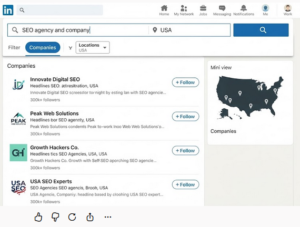
- Type “SEO agency” or the client’s anchor text into the LinkedIn search bar.
- Set the location filter to United States.
- Choose either the Companies or People filter.
- If you choose Companies, open each company page and go to its People tab.
- Look for roles like CEO, Founder, Head of SEO, Head of Social Media or Head of Content Writing.
- Send a connection request to each relevant person.
Example: Searching LinkedIn with “pak seo training”
Search 1: pak seo training + location United States + filter Companies. Open a company page, go to People, and connect with the CEO or SEO head.
Search 2: SEO agency + location United States + filter People. Connect with founders, SEO heads, social media heads and content writing heads.
Who should you connect with first?
SEO agencies are often the best target. Many US agencies outsource link building to save time, so one agency client can bring you repeat orders for many of its own customers. After agencies, target business owners and marketing heads at companies in the niche of your anchor text.
Keep your daily connection requests steady, around 15 to 20 per day, rather than sending large batches. LinkedIn limits how many invitations you can send, and a steady pace looks more natural and keeps your account safe.
Tip: One US agency that outsources link building can be worth more than twenty single-business clients.
Sending Outreach That US Clients Actually Answer
Once you have email IDs and connections, your message decides whether you get a reply. Keep it short, personal and specific.
What should a good first email include?
- The business name and the keyword you noticed they target
- One line on how you can help them rank for that keyword
- A simple question as the call to action, such as “Would you like to see a few site options?”
- Your real name, company and contact details
Example: A short first email
Subject: Backlinks for “pak seo training”
Hi John,
I noticed your website is working to rank for “pak seo training”. We place backlinks on relevant, high-traffic sites that can help with that keyword.
Would you like to see a few site options?
Thanks,
[Your name], [Your company]
[Your business address]
Reply “no thanks” and I will not contact you again.
Which US email rules must you follow?
Cold emails to US businesses fall under the CAN-SPAM Act. The FTC’s CAN-SPAM compliance guide makes clear the law is not limited to bulk email, and it covers business-to-business messages too. In simple terms, every outreach email should:
- Use an honest subject line that matches the message
- Show accurate sender information
- Include your valid physical business address
- Give a clear way to opt out, and honor opt-out requests promptly
Following these rules protects your domain reputation as well as keeping you on the right side of the law.
How often should you follow up?
Send one follow-up after 3 to 4 days and a final one after 7 days. Many replies come from follow-ups, not the first email. Stop after the third message if there is no response.
Why USA Clients Are Worth the Extra Effort
USA clients are more active and higher paying than many other markets. There are a few reasons:
- Competitive search results. US keywords are crowded, so businesses need strong backlinks to rank.
- Bigger marketing budgets. Many US small businesses set aside a monthly budget for SEO.
- Repeat orders. Once a US client sees results, they tend to order links regularly instead of one time.
- Fast decisions. Owners of small US businesses can approve an order quickly without long approval chains.
For an offshore link builder, the time zone difference can even be an advantage. You can prepare reports and links overnight so the client sees progress when their day starts.
Common Mistakes That Waste Your Leads
- Using generic anchor texts. Words like “click here” or “read more” do not reveal a niche. Pick keyword-rich anchors.
- Targeting only big brands. Large companies usually have in-house SEO teams.
- Skipping the activity check. Emailing inactive businesses lowers your reply rate and hurts your email reputation.
- Sending copy-paste emails. Mentioning the business and keyword by name makes a big difference.
- No tracking sheet. Without a spreadsheet of sites, emails, dates and replies, you will contact the same people twice or forget follow-ups.
A Simple Lead Tracking Sheet
Use one spreadsheet for all three methods. These columns are enough:
| Column | What to record | Example |
|---|---|---|
| Anchor text | The keyword you used to find the lead | pak seo training |
| Source | Google, Google Maps or LinkedIn | |
| Business / person | Website or LinkedIn profile | ABC SEO Academy |
| Email ID found on the site | info@abcseoacademy.com | |
| First contact date | When you sent the first message | Nov 3 |
| Follow-ups | Dates of follow-up 1 and 2 | Nov 6, Nov 10 |
| Status | No reply, interested, ordered, not interested | Interested |
Review the sheet every week. You will quickly see which anchor texts and which method bring the most paying clients, and you can focus more time there.
FAQ
What is the Google formula to find USA link building clients?
Type “need + services + keyword + Country” into Google. Replace keyword with the client’s anchor text and Country with USA, for example “need + services + pak seo training + USA”.
Is it okay to use another client’s anchor text to find leads?
Yes. You are only using a public keyword as a search term to find other businesses in the same niche. You do not share or reveal anything about the original client.
How many leads can I find with this method each week?
With 20 anchor texts and about one hour per method per day, finding 150 to 250 qualified US leads per week across all three methods is realistic.
Which of the three methods works best?
Google search gives the most volume, Google Maps gives the most active businesses, and LinkedIn gives direct access to decision makers. Using all three together gives the best results.
Do I need paid tools to find link building clients in the USA?
No. Google, Google Maps and a free LinkedIn account are enough to start. Paid tools only help you scale later.
How long does it take to get the first client?
If you contact around 30 qualified leads per day and follow up properly, many link builders get their first replies within the first week and a first order within two to four weeks.
Start Finding USA Clients Now
Here is your action plan to find link building clients in the USA using anchor text:
- Open any admin’s guest posting website, check client posts, and copy the anchor text (the keyword the link is added on).
- Search Google with
need + services + keyword + Country, for exampleneed + services + pak seo training + USA, and collect email IDs from each website. - Search Google Maps with the anchor text plus “in USA”, for example
Pak SEO Training in USA, and keep only businesses with under 100 reviews whose owners reply to reviews. - Search LinkedIn for “SEO agency” or the anchor text, set the location to United States, and connect with CEOs and heads of SEO, social media and content writing.
- Send short, personal, CAN-SPAM-compliant emails that mention the business keyword.
- Follow up after 3 to 4 days and again after 7 days.
- Track every lead in one spreadsheet and double down on what converts.
The clients are already out there, and their keywords are hiding in plain sight inside every guest post. Start this week.

Muhammad Amjad Butt
SEO Trainer, CEO & Founder of PB Outreach
Muhammad Amjad Butt is an SEO specialist with 21+ years of experience, the CEO and founder of PB Outreach, and the trainer behind Pak SEO Training. He has trained 500+ students and completed 1,000+ guest posting projects for clients.
📚 Related Posts
How to Find Guest Post Buyers Using Google Ads Transparency
Find guest post buyers free with Google Ads Transparency Center. Search a niche, switch to the US region, read ad signals and…
6 Cold Email Mistakes That Lose Link Building Clients
Sending site lists, long emails and unread ChatGPT pitches kills replies. Learn 6 cold email mistakes that lose clients, with examples and…
VIP SEO Guest Manager: Role, Cost & How to Choose
What does a VIP SEO guest manager do? Learn the role, pricing, red flags, Google’s link rules and a 7-step checklist to…