Poisoned Google Results: Is Your Ranking Drop Fake?
Poisoned Google results are normal-looking search pages with the wrong websites in them, which Google has been serving to rank trackers since September 2026. Your tool may show your page falling from position 3 to 58 while real Google users still see you at position 3. Before you change anything, check Search Console, search the keyword yourself, and wait 3 days.
In this article
- What Are Poisoned Google Results?
- Why Is Google Sending Wrong Results to SEO Tools?
- How Big Is the Problem? The Numbers
- Which Sites Take Your Place?
- How to Tell a Fake Drop From a Real One
- Free Tool: Fake Ranking Drop Checker
- Which Keywords and Niches Are Hit Most?
- How to Explain a Fake Drop to Your Client
- What Are Ahrefs, Semrush and Other Tools Doing?
- The Hidden Page 2 Problem
- FAQ
- Start Checking Your Rankings the Right Way Now
You open your rank tracker in the morning and your best keyword has fallen out of the top 10. Your heart drops. You start rewriting the page, buying links or blaming the last update. Stop. Since September 2026, a big share of these “drops” are not real. They are poisoned Google results, also called poisoned SERPs, and they are fooling SEO tools all over the world.
Fake Ranking Drop Checker
Answer 7 quick questions. Find out in 10 seconds if your ranking drop is real or just poisoned rank tracker data.
This tool runs in your browser. Nothing you type is saved or sent anywhere. Based on public research by Nozzle, DataForSEO and Ahrefs (October 2026).
This guide explains what poisoned Google results are, why they happen, how many rankings they affect, and a simple 6-sign test to tell a fake ranking drop from a real one. You also get a free checker tool and a ready-to-send note for clients.
A fake ranking drop that you “fix” can turn into a real one. The worst move is to panic.
What Are Poisoned Google Results?
A poisoned Google result is a complete search results page that looks 100% normal, but most of its organic results have been swapped for different, often unrelated, websites. There is no error message, no captcha and nothing in the page code that marks it as fake.
The term comes from Nozzle’s research study “Poisoned Google SERPs”, which tracked about 30 million search pages. Rank trackers collect these pages automatically, so when Google sends a poisoned page, the tool saves it as real data and reports a ranking drop that never happened for real users.
Three simple terms you need to know:
- SERP: Search Engine Results Page, the page Google shows after a search.
- Rank tracker: a tool such as Ahrefs, Semrush or Nozzle that checks your positions every day by sending automated searches to Google.
- Scraping: collecting search pages automatically with software instead of a human typing the search.
Why Is Google Sending Wrong Results to SEO Tools?
Google has not officially confirmed or explained this behaviour. What we know comes from the data companies that collect search results.
Nozzle’s data shows a clear order of events:
- September 13, 2026: automated requests to Google started failing in large numbers.
- September 20, 2026: the requests that got through began coming back as poisoned pages.
Nozzle says this is Google’s response to AI scraping, with rank trackers caught in the middle. Here is why poisoning hurts more than simple blocking:
| What Google does | What the tool sees | Result for you |
|---|---|---|
| Blocks the request | An error or captcha | The tool tries again. Your data stays correct. |
| Sends a poisoned page | A normal-looking page | The tool saves wrong data. You see a fake drop. |
Semrush describes these pages as results that differ from what a typical Google user would see. The poisoned pages show up in data collected by tools, which is why a manual check from your own browser is so useful.
How Big Is the Problem? The Numbers
This is not a small glitch. Here are the key numbers from Nozzle’s study (data up to October 21, 2026):
| Measure | Before (Aug 20 to Sep 9) | Since Sep 13, 2026 |
|---|---|---|
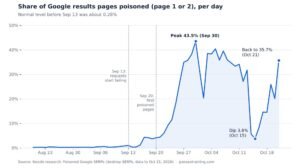
| Search pages poisoned on page 1 or 2 | 0.28% | 22.6% (peak 43.5% on Sep 30) |
| Tracked site missing from the top 10 | 2.7% | 60.8% of poisoned pages |
| Usual sites kept from the previous check | 88.1% | 22.3% on poisoned pages |
| Usual sites back within 3 days | n/a | 67.9% (92.5% within 2 weeks) |
The problem did not go away. It dropped to 4 to 6% on October 14 and 15, then climbed back to 35.7% on October 21. If you saw strange swings in late October, read our report on Google ranking changes in October 2026 too, because real volatility and fake data happened at the same time.
Key insight: On poisoned pages, your site was out of the top 10 about 6 in 10 times. But in about 2 out of 3 cases, the normal results came back within 3 days. A one-day crash is now more likely to be bad data than a real loss.
Which Sites Take Your Place on a Poisoned Page?
When results are poisoned, your usual competitors disappear and social platforms and forums move in. Facebook appeared in the top 10 of 29.5% of poisoned pages, compared with 21.9% of normal pages for the same keywords.
A real example from the study: for the keyword “white label local seo” (desktop, United States), the page on October 4 listed white-label SEO companies. Three days later, all 9 page-1 sites were gone. The new results included a WordPress development tool, a steakhouse in Jackson Hole, a directory of county health departments and USA.gov. Every result matched the word “local”, and none matched “white label SEO”.
Other examples from the same study:
- “heating and cooling services queens” (iPhone, Queens, New York): 8 of 10 page-1 sites gone
- “jewellery buyers near me” (desktop, Canada): 8 of 9 page-1 sites gone
- “gold buyers near me” (desktop, Canada): 7 of 9 page-1 sites gone
If a steakhouse is outranking your SEO agency, the data is broken, not your page.
How to Tell a Fake Ranking Drop From a Real One
This is the most important part of this guide. Use these 6 signs before you touch your page:
| Sign | Likely fake (poisoned) | Likely real drop |
|---|---|---|
| 1. How long it lasts | 1 day, back within 3 days | Stays low for 7 days or more |
| 2. Search Console | Clicks and impressions look normal | Clicks and impressions fall too |
| 3. Who replaced you | Facebook, Reddit, forums or off-topic pages | Real competitors on your topic |
| 4. Other keywords | Random keywords on random days | A group of related pages drops together |
| 5. Page 2 | Off-topic, or matches only one word of the query | Normal, relevant results |
| 6. Manual check | You still see your page in its usual place | You also see it lower |
Sign 2 is your strongest test. Nozzle puts it simply: if a site “disappears” in a tool but Search Console still shows impressions and clicks, nothing happened to the site. Search Console data comes from real users, not from scraping, so poisoned pages cannot touch it.
Compare with history, not with yesterday. Yesterday’s result may have been poisoned too. Look at which sites usually ranked for the keyword over the past few weeks.
Quick win this week: Open Search Console, go to Performance, filter by the page that “dropped”, and compare the last 7 days with the previous 7 days. If clicks and impressions are within 10 to 20% of normal, mark the drop as unconfirmed and do nothing for 3 days.
Free Tool: Is Your Ranking Drop Fake or Real?
Answer 7 quick questions and get a clear answer, a reason for each sign, next steps and a ready-to-send note for your client or boss. Nothing you type is saved.
Fake Ranking Drop Checker
Answer 7 quick questions. Find out in 10 seconds if your ranking drop is real or just poisoned rank tracker data.
This tool runs in your browser. Nothing you type is saved or sent anywhere. Based on public research by Nozzle, DataForSEO and Ahrefs (October 2026).
Which Keywords and Niches Are Hit Most?
Poisoning does not hit every keyword equally. Nozzle found these patterns:
- “Near me” searches: 13.6% poisoned, against 8.6% for everything else.
- Long-tail keywords: 10.3% for keywords under 100 searches a month, against 6.6 to 7.6% for bigger keywords.
- Brand searches: lowest, at 5.3%.
- Device: almost no difference (8.8% desktop, 8.8% iPhone, 7.7% Android).
By industry in the United States, since September 13 (page 1):
| Industry | Poisoned share | Worst day |
|---|---|---|
| Legal | 17.4% | 54.6% (Sep 27) |
| Home services | 15.0% | 51.5% (Sep 29) |
| Travel and hospitality | 11.0% | 41.2% (Sep 28) |
| Software and technology | 9.2% | 29.7% (Sep 27) |
| Real estate | 7.0% | 28.8% (Sep 27) |
| Pets | 4.4% | 13.8% (Sep 28) |
By country, India (12.6%), Australia (12.9%) and Canada (11.0%) were hit harder than the United States (8.8%) and the United Kingdom (4.1%). If you do local SEO or work with US local service clients, expect more fake drops than average.
How to Explain a Fake Ranking Drop to Your Client
For agencies and freelancers, the real damage is trust. A client sees a red arrow in your report and thinks your work failed. Here is how to handle it:
- Do not send raw tool screenshots of one-day drops.
- Add an “unconfirmed” label to any drop that has not been checked against Search Console.
- Report the position held for 3 days for volatile keywords. This is the method DataForSEO recommends.
- Show Search Console clicks next to rankings so the client sees real traffic.
- Explain it once, in simple words, before the client asks.
Here is a short note you can copy:
“Our rank tracker showed a drop for one of your keywords. Since late September 2026, Google has been sending wrong results to SEO tools, which the industry calls poisoned SERPs. Search Console shows no real loss, so we have marked this drop as unconfirmed and will check again in 3 days.”
Need a clean report format? Use our free SEO report template for link building and add an “unconfirmed” column next to each ranking.
What Are Ahrefs, Semrush and Other Tools Doing?
The big SEO data providers have all spoken about it:
| Company | What they said |
|---|---|
| Ahrefs (Oct 22) | 5% to 20% of results affected, depending on the data provider. Filters now reject bad results, and past data is being cleaned. |
| Semrush (Oct 27) | Confirmed the issue since late summer. Filters invalid pages and collects them again. Did not share how many results were affected. |
| DataForSEO | About 20% to 30% of scraped results poisoned since Sep 26. Even after two retries, 2% to 3% stay poisoned. |
| Nozzle | 22.6% of pages poisoned on page 1 or 2 since Sep 13, with a 43.5% peak. |
Ahrefs called it an “industry-wide issue impacting many companies in our space.” The numbers differ because each company measures in a different way and collects data differently. They all agree on one thing: rank tracking data is less reliable right now, so you need a second source.
The Hidden Page 2 Problem Most SEOs Miss
Most people only check page 1. But Nozzle found that page 2 is poisoned 1.5 times as often as page 1. In 58.4% of cases where page 2 was poisoned, page 1 still looked completely fine.
For about two weeks in September, page 2 often answered just one word of the search instead of the full query. So if your keyword normally sits at position 11 to 20, a tool may report it as “lost” while page 1 looks normal.
What this means for you:
- Be extra careful with “striking distance” keywords (positions 11 to 20).
- Do not judge a content update by one page-2 reading.
- Check page-2 keywords manually before you report them as lost.
Frequently Asked Questions
Are poisoned Google results a penalty on my site?
No. Poisoned results affect the data that tools collect, not your website. Your site has not been penalized just because a tool showed a drop.
Do real Google users see poisoned results?
There is no proof that they do. Semrush describes poisoned pages as results that differ from what a typical user sees. Your Search Console clicks are the best way to check what real users see.
Has Google confirmed poisoned SERPs?
Not as of early November 2026. Google has not publicly commented on the reports from Nozzle, Semrush or Ahrefs.
How long does a fake ranking drop last?
Usually 1 to 3 days. In Nozzle’s data, 4 out of 5 poisoned spells were a single check, and 67.9% of keywords had their usual sites back within 3 days.
Should I stop using rank trackers?
No. Keep using them, but treat a single-day drop as unconfirmed and always compare with Search Console before you act.
Can poisoned results affect my traffic numbers?
No. They affect ranking reports from tools. Your real traffic in Google Analytics and Search Console is not changed by poisoned pages. Free traffic estimators that use ranking data may be affected, so cross-check with our website traffic checker and your own analytics.
Start Checking Your Rankings the Right Way Now
Poisoned Google results are one of the biggest rank tracking problems of 2026. A fake ranking drop is not your fault, but reacting to it can cost you a good page. Follow these steps every time you see a sudden drop:
- Do not change the page on the day of the drop.
- Check Search Console clicks and impressions for the same page and days.
- Search the keyword yourself in a private browser window.
- Look at which sites replaced you: real competitors or unrelated pages?
- Run the free Fake Ranking Drop Checker above.
- Re-check after 3 days and report the 3-day position.
- Act only if the drop lasts 7 days or more and Search Console confirms it.
Have a ranking drop you are not sure about? Ask a free SEO question and get a short, clear answer. For more updates like this, follow our SEO news section.
Check your data before you change your content. Start this week.

Muhammad Amjad Butt
SEO Trainer, CEO & Founder of PB Outreach
Muhammad Amjad Butt is an SEO specialist with 21+ years of experience, the CEO and founder of PB Outreach, and the trainer behind Pak SEO Training. He has trained 500+ students and completed 1,000+ guest posting projects for clients.
📚 Related Posts

2 Hidden SEO Mistakes Site Owners Never Notice
Your site looks fine but won’t rank? These 2 hidden SEO mistakes (indexing blocks and keyword cannibalization) are the reason. Find and…

SEO Report Template for Link Building (Free Sample + SEO Experts Opinion)
Free SEO report template with a filled sample for link building and guest post campaigns. Track live links, indexing, anchors, rankings and…

Where Is This US SEO Agency? Location and Website Lookup
Want to know where a US SEO agency is based? Search 173 top agencies and instantly see each one’s country, city and…