Your LinkedIn “About” section is not a place for a copy-pasted resume or a formal biography. When treated like a digital graveyard of buzzwords, profile visitors leave without taking action. To drive actual results, treat your summary like a high-converting landing page designed to turn recruiters, hiring managers, and prospective clients into direct inbound leads.
The Generic Profile Trap: Why Most LinkedIn Summaries Fail
Most LinkedIn summaries begin with vague, uninspired statements: “Results-driven professional with a passion for excellence, looking for new and challenging opportunities.”
These openings carry zero measurable proof and deliver no distinct value. Recruiters scan hundreds of identical profiles daily, and fluff-filled descriptions are skipped instantly.
The Cost of Buzzwords
- Zero Differentiation: Using words like “hardworking,” “passionate,” or “team player” makes you blend in rather than stand out.
- No Social Proof: Broad claims without figures or outcomes fail to build credibility.
- Lost Inbound Opportunities: A passive profile leaves visitors confused about how you can actually help them.
Weak vs. High-Converting LinkedIn Summaries (Real Examples)
To build a profile that converts, replace vague promises with specific niches, technologies, and verifiable metrics.
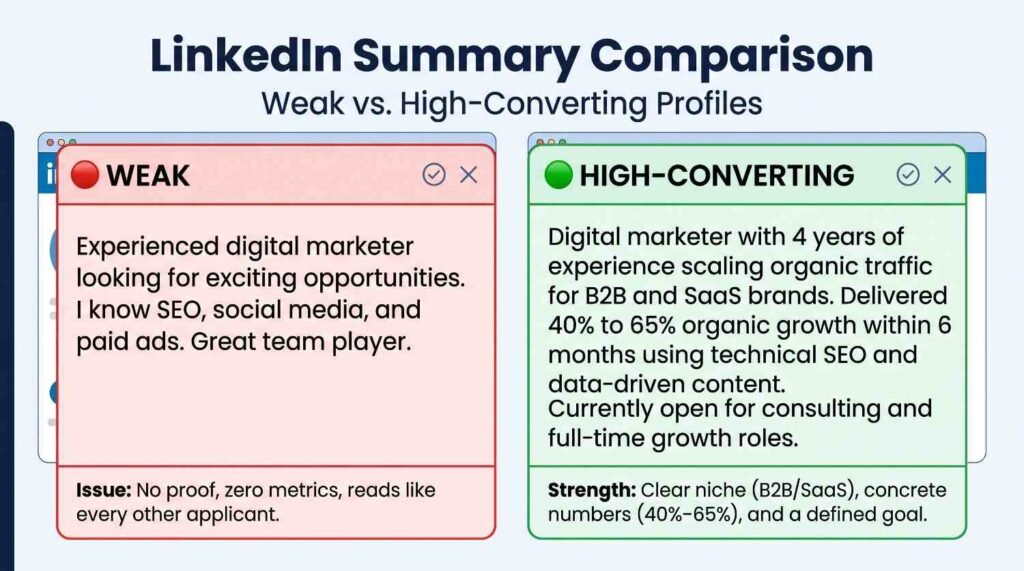
1. Digital Marketer Example
- ❌ Weak (Generic):
“Experienced digital marketer looking for exciting opportunities. Skilled in SEO, social media, and paid advertising. Great team player who always delivers.”
Why it fails: Lacks proof, features no metrics, and looks identical to thousands of other applicants.
- ✅ High-Converting (Results-Driven):
“B2B and SaaS Digital Marketer with 4+ years of experience driving organic revenue growth. Scaled organic search traffic by 40% to 65% in 6 months using technical SEO and data-driven content strategy. Currently open for consulting engagements and full-time growth leadership roles.”
Why it works: Highlights a clear niche (B2B/SaaS), precise metrics (40% to 65%), and a clear call to action.
2. Software Engineer Example
- ❌ Weak (Generic):
“Software engineer with good programming skills. I love coding, solving problems, and building apps. Available for hire.”
Why it fails: Vague skill descriptions and zero business impact.
- ✅ High-Converting (Results-Driven):
“Full Stack Developer specializing in React, Node.js, and high-throughput microservices. Built and shipped production features for 2 venture-backed startups with zero critical downtime. Open to remote Senior Developer positions.”
Why it works: Mentions exact tech stacks, highlights operational reliability, and targets specific positions.
The 3-Second Hook Rule: Captivating Above the Fold
LinkedIn truncates your summary after the first two lines, showing a “See more” prompt. If those initial lines fail to grab attention, visitors will scroll away.
+-----------------------------------------------------------------------+
| [Line 1] Help [Target Audience] achieve [Core Outcome] through [Skill]|
| [Line 2] Over X years, generated [Key Metric/Result].                 |
| ... [See more]                                                        |
+-----------------------------------------------------------------------+
Key Principles for Your Hook
- State Your Value Instantly: Clearly define who you serve and the primary problem you solve.
- Eliminate Setup Fluff: Skip greetings like “Welcome to my profile” or repeating your current job title.
- Trigger the Click: Put your strongest achievement or metric upfront so visitors click “See more.”
Plug-and-Play LinkedIn Summary Templates
Copy, customize, and deploy these structural frameworks based on your career goals.
Template 1: Freelancers, Consultants & Service Providers
Hook: I help [target client type] achieve [specific outcome/ROI] through [core service/skill].
Proof & Experience: Over the past [X years], I have [delivered X result / managed $Y budget / completed Z projects]. My focus centers on removing [primary client pain point] while optimizing [key metric].
Core Specialties:
- Skill/Service 1
- Skill/Service 2
- Tool/Framework 3
Call to Action: Looking to scale your [area of expertise]? Send me a direct message here on LinkedIn or email me at [your email address].
Template 2: Experienced Job Seekers & Remote Professionals
Hook: [Target Role/Title] specializing in [Core Sub-Niche or Tech Stack].
Track Record: Over [X years] of hands-on experience driving performance at [industry/type of companies]. Most recently, I [achieved specific business result or shipped key product], leading to a [X%] improvement in [KPI].
Technical Toolkit:
- Platforms/Languages: [Skill 1, Skill 2, Skill 3]
- Methodologies: [Framework 1, Framework 2]
Call to Action: Currently exploring [Full-Time / Remote / Contract] opportunities in [Industry]. Connect with me here or contact me directly at [your email address].
Template 3: Students, Career Switchers & Fresh Graduates
Hook: [Degree/Certification] graduate skilled in [Top 2–3 Core Skills], with hands-on project experience in [Industry/Specialty].
Practical Background: Recently completed [Capstone Project / Internship / Freelance Work], where I [built/designed/managed X] using [Tools/Technologies]. Certified in [Relevant Certification Name].
Key Strengths:
- [Skill 1]: [Brief 1-line context]
- [Skill 2]: [Brief 1-line context]
Call to Action: Actively seeking entry-level roles in [Target Roles]. Feel free to send a connection request or email me at [your email address].
Metrics Over Plain Words: How to Quantify Your Impact
To stand out to recruiters and enterprise clients, replace subjective adjectives with objective, measurable data.
| Avoid Subjective Claims ❌ | Use Objective Metrics ✅ |
|---|---|
| “Expert at digital ad campaigns” | “Managed $75K monthly ad spend at 3.4x ROAS” |
| “Experienced team manager” | “Recruited, onboarded, and managed a team of 12 engineers” |
| “Skilled in system performance” | “Reduced API response times by 45% using Redis caching” |
| “Great at generating sales leads” | “Outbound email campaigns generated $120K in new pipeline” |
Metrics to Feature
- Percentages: Growth rates, efficiency improvements, error reductions, retention lifts.
- Volume & Scale: Dollars managed, users acquired, code shipped, systems maintained.
- Tooling: Explicit names of industry-standard software, languages, and frameworks.
Closing with a Clear Call to Action (CTA)
Never leave profile visitors guessing about what to do next. End your LinkedIn “About” section with a single, direct instruction.
High-Converting CTA Examples
- For Consultants & Freelancers: “Ready to scale your organic growth? Send a direct message on LinkedIn or email me at contact@yourdomain.com.”
- For Job Seekers: “Open to remote Senior Product Designer opportunities. Let’s connect here or reach me directly at name@email.com.”
- For Networking & Thought Leaders: “I regularly share insights on technical SEO and Web3 development. Follow my profile or reach out via direct message to collaborate.”