Thank you for reading this post, don't forget to subscribe!
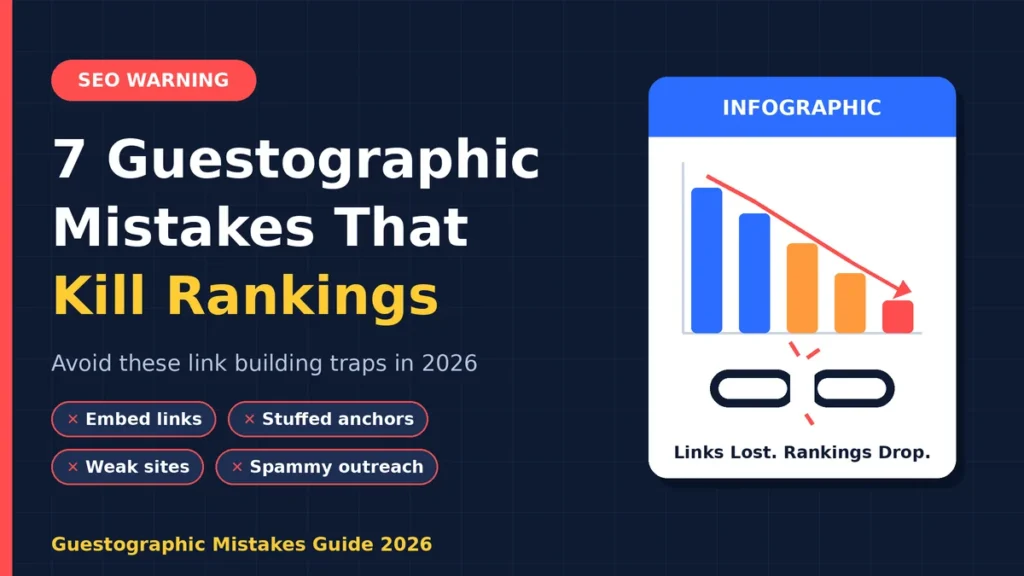
- Quick answer: Guestographics fail because of embed-code links, stuffed anchors, weak sites, copy-paste outreach, mobile-unfriendly designs, image-only content and scaling too fast.
- The guestographic method looks easy (infographic + unique intro = backlink), but in 2026 many campaigns bring zero ranking gains or even trouble.
- The idea isn’t the problem. These 7 repeated mistakes are, and below you’ll see why each one hurts rankings and how to fix it.
What Is a Guestographic? (30-Second Refresher)
A guestographic combines an infographic with a guest post. You publish an infographic on your own site and then contact relevant bloggers. You offer them the graphic plus a short, unique introduction written only for their site. That intro includes a contextual link back to you.
The host gets free visual content. You get exposure and a backlink. When it is done well, this is one of the cleaner forms of infographic link building. When it is done badly, it is just another link scheme with nice colours.
7 Guestographic Mistakes That Kill Rankings
Mistake 1: Relying on Embed-Code Links
The classic infographic trick was an embed box under the image: “Share this infographic on your site”, with your link hidden inside the code. Thousands of sites copied it, and thousands of identical links pointed back to the creator.
Why it hurts: Google lists keyword-rich, hidden or low-quality links placed in widgets distributed across many sites as part of link schemes. Embed links sit at the bottom of the page, usually with the same anchor every time, and the person who copied the code never chose to link to you. These links pass little value, and at scale they look unnatural.
Fix: Treat the embed code as a bonus, never the goal. The real value of a guestographic is the contextual link inside the unique intro you write, placed naturally within a sentence. If a site only wants the embed code, the deal is not worth much.
Mistake 2: Stuffing Keyword-Rich Anchor Text
Many people put their exact money keyword into every intro, such as “best cheap SEO services in Lahore”. Twenty guestographics later, their backlink profile shows the same commercial anchor again and again.
Why it hurts: Natural links use varied anchors: brand names, URLs, “this guide”, partial phrases. A profile full of exact-match anchors is one of the easiest manipulation patterns for Google to spot. Your link can be devalued, or the page you are trying to rank can be held back.
Fix: Mix your anchors. Use mostly brand or natural phrase anchors, some partial-match, and only an occasional exact-match. Also let the host editor adjust the wording. Links that editors approve read more naturally.
Mistake 3: Pitching to Irrelevant or Low-Quality Sites
It is tempting to accept any site that says yes. A home décor blog, a crypto news site and a general “write for us” site all end up publishing your SEO infographic.
Why it hurts: Relevance matters more than raw authority. A link from a small site in your niche usually helps more than one from a large site with no topical connection. Worse, many sites that publish anything for free are content farms or private blog networks. Links from them can drag your profile down instead of lifting it.
Fix: Before you pitch, check each prospect for real organic traffic, topical match and an editorial standard (do they reject weak content?). Planning your target sites first saves you from chasing junk links. You can map niches, traffic and links per month with our free backlink planner tool before you send a single email.
Mistake 4: Sending Copy-Paste Outreach
“Hi there, I loved your blog. Would you like to publish my infographic?” Editors get messages like this all day, and most of them get deleted.
Why it hurts: Low response rates are the biggest silent killer of guestographic outreach. You spend money on design, then get a handful of placements, often only from sites that accept everything (see Mistake 3). The few links you do earn come from the least selective sites.
Fix:
- Name a specific article on their site that your graphic would support.
- Explain the value to their readers in one line, not the value to you.
- Offer the unique intro up front so they see it costs them no work.
- Follow up once, politely, and then move on.
Mistake 5: Designing an Infographic That Breaks on Mobile
Most guestographics are still designed for a desktop screen: a tall graphic, 800+ pixels wide, packed with small text. On a phone, readers have to pinch and zoom, and most simply scroll past.
Why it hurts: Most readers browse on mobile, and Google ranks with mobile-first indexing. Huge, heavy image files also slow the host page. Editors know this, so many of them reject large infographics outright. A graphic that hurts their page speed is a graphic they will not publish.
Fix: Design mobile-first. Use larger fonts, fewer sections and a narrower layout, or split the infographic into 3 to 5 smaller “mini-graphics” the host can place through an article. Compress every file to WebP and keep it light so it does not slow anyone’s page.
Mistake 6: Hiding All the Value Inside the Image
Many creators put every statistic, tip and step inside the picture and surround it with just two lines of text. To a reader, it looks fine. To a search engine or an AI answer tool, the page is almost empty.
Why it hurts: Search engines and AI systems understand text far better than text baked into an image. A thin page with one big graphic gives Google little to rank, and gives AI tools nothing to quote. The host page performs poorly, so your link sits on a page few people ever see.
Fix:
- Write an intro of real substance (250 to 400 words) for each host, not two filler lines.
- Add a short text summary of the key points under the graphic.
- Use descriptive alt text and a clear file name.
- On your own copy of the infographic, publish a full text version so your page can rank too.
Mistake 7: Scaling the Method Until It Looks Like a Link Scheme
Once a guestographic works, the urge is to repeat it fast: one graphic, 100 sites, same intro template, same anchor, all in a month.
Why it hurts: Google’s guidelines name large-scale guest posting campaigns with keyword-rich anchors as a link scheme. Repeating one formula across dozens of sites in a short time creates an obvious footprint: similar intros, identical anchors and a sudden spike in links. That pattern is exactly what algorithms and manual reviewers look for. One of the most common link building mistakes is turning a quality tactic into a volume tactic.
Fix: Keep link velocity steady and natural. Use the guestographic for a few strong placements, then mix in other methods: real guest posts, niche edits on relevant sites, digital PR and brand mentions. If you would rather not manage all this yourself, our link building services use real-traffic websites and no PBNs.
Guestographic Mistakes at a Glance
| Mistake | Ranking Risk | Quick Fix |
|---|---|---|
| Embed-code links | Links ignored or seen as a scheme | Earn contextual links in a unique intro |
| Keyword-stuffed anchors | Over-optimisation signal | Use brand and natural anchors |
| Irrelevant or weak sites | Low value or toxic links | Vet niche, traffic and editorial quality |
| Copy-paste outreach | Few links, mostly from weak sites | Personal, reader-focused pitches |
| Desktop-only design | Rejected pitches, slow pages | Mobile-first, compressed graphics |
| All value inside the image | Thin host page, poor visibility | Add real text, summary and alt text |
| Scaling too fast | Footprint and penalty risk | Steady pace, mixed link methods |
Pre-Launch Guestographic Checklist
Run through this list before you send your first pitch:
- Is the topic genuinely useful to the host’s readers, not just to you?
- Is the graphic readable on a phone without zooming?
- Is the image file compressed and light?
- Does every host get a different, substantial intro?
- Does the link sit inside a sentence, with a natural anchor?
- Has every prospect been checked for traffic, relevance and quality?
- Is your outreach spread over weeks, not dumped in one day?
If you answer “no” to any of these, fix it first. One strong placement on a relevant site is worth more than twenty weak ones.
Are Guestographics Still Worth It in 2026?
Yes, but only as a quality tactic, not a shortcut. Guestographics still work when the graphic is genuinely useful, the link is contextual, the host site is relevant and the campaign moves at a natural pace. They fail when people treat them as a cheap way to mass-produce backlinks.
Think of a guestographic as a relationship-starter with editors in your niche, not a link factory. The sites that publish your graphic today may accept a full guest post or a collaboration tomorrow.
Frequently Asked Questions
Can guestographics get my site penalised?
The tactic itself is not a violation. The risk comes from how it is used: hidden embed links, keyword-stuffed anchors and large-scale campaigns can all match Google’s description of link schemes. Natural, contextual links on relevant sites are low-risk.
Are embed-code backlinks useless?
Not completely, but they are weak. Contextual links inside a unique intro are far more valuable. Never make embed links the main goal of your campaign.
How many guestographic links should I build per month?
There is no magic number. Focus on a steady, believable pace that fits your site’s size and history, and combine guestographics with other link building methods rather than relying on just one.
Do infographics still help SEO?
Yes, when they come with real text. Infographics improve engagement and shareability, but the text around them is what search engines and AI tools actually read and rank.
Final Thoughts
Guestographics did not stop working. Careless guestographics stopped working. Avoid these seven guestographic mistakes and you turn a tired tactic into a clean, relevant way to earn links that actually move rankings.
Want to learn link building, outreach and off-page SEO step by step with real examples? Explore our practical SEO training and start building links the right way.