1. What Is a Listicle? (Definition and Core Structure)
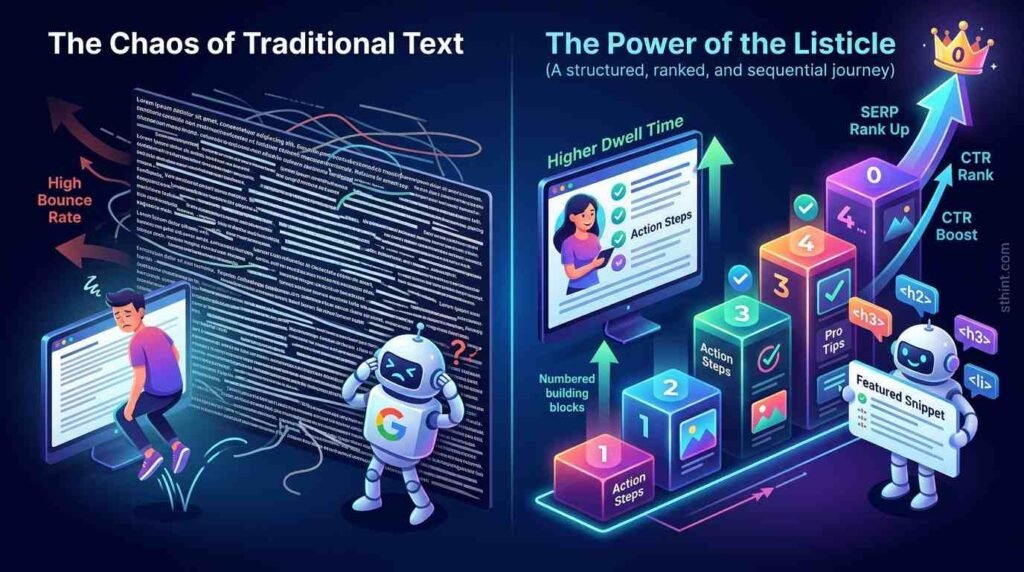
A listicle (a portmanteau of “list” and “article”) is an article structured around a numbered or bulleted list. Unlike traditional long-form narrative essays that require continuous reading, a listicle breaks complex concepts down into bite-sized, modular sections.
Types of Listicles
Listicles generally fall into three main categories:
-
Unranked Lists: A collection of relevant items where order does not imply quality (e.g., 15 Great Ideas for Home Office Decor).
-
Ranked Lists: Items ordered by quality, performance, or preference (e.g., Top 10 Best SEO Plugins for WordPress Ranked).
-
Sequential Lists: Step-by-step guides where order represents a workflow (e.g., 7 Steps to Launch Your First E-commerce Store).
Real-World Title Examples
-
Standard Informational: 10 Proven Strategies to Lower Facebook Ad Costs
-
Product Comparison: 5 Best Keyword Research Tools for Beginners (Compared)
-
How-To Workflow: 8 Simple Steps to Technical Site Audits
By presenting a number directly in the main headline, listicles give readers clear expectations about the value and length of the content before they even click.
2. Why Listicles Are Powerful for SEO
Search engines like Google prioritize user experience above all else. Google’s algorithm rewards content that satisfies search intent, presents clear information hierarchy, and keeps users engaged. Here is how listicles directly boost your SEO metrics:
A. Higher Click-Through Rates (CTR)
The search engine results page (SERP) is a crowded battleground. Titles that include numbers consistently outperform standard headlines in organic click-through rates. Numbers signal to users that the information is structured, actionable, and easy to skim.
-
Standard Title: How to Improve Your Website Speed
-
SEO Listicle Title: 9 Proven Ways to Speed Up Your WordPress Site in 2026
The second title immediately sets an expectation of concrete, numbered solutions, making it far more enticing to click.
B. Winning Featured Snippets (Position 0)
Google frequently displays Featured Snippets at the top of search results for informational searches. Because listicles rely heavily on clear HTML tags (<h2>, <h3>, <ol>, <ul>), Google’s crawlers can parse and extract your list items with ease.
Example of Featured Snippet Target: If a user searches “How to improve site speed,” Google often pulls the
<h2>headings directly from a well-structured listicle and displays them as a bulleted snippet at the top of the page.
C. Reduced Bounce Rates and Higher Dwell Time
When visitors land on a page with dense, uninterrupted walls of text, they often back out to the search results immediately—a signal known as “pogo-sticking.” Listicles prevent this by using bold headings, short paragraphs, and bullet points. Users quickly find what they need, stay on the page longer, and engage with the content, sending positive signals to Google’s algorithm.
D. Natural Internal and External Linking Structure
List-based content naturally accommodates context-rich links. For instance, in a listicle titled “10 Must-Have SEO Tools,” each sub-heading provides an organic opportunity to link out to vendor sites or link internally to in-depth reviews on your own website.
3. Real-World Case Study: Bad Listicle vs. Good Listicle
To illustrate the difference structure makes, let us compare a poorly written listicle with an SEO-optimized listicle.
Example A: Poorly Formatted (Low SEO Value)
5 SEO Tips
First, you need to do keyword research because keywords are important for ranking on Google. You should use tools. Second, write good content that users like to read and share on social media. Third, build backlinks from authority websites to raise your domain authority. Fourth, optimize your images so they load faster. Fifth, check your technical SEO regularly.
Why it fails: It lacks clear sub-headings, uses generic advice, misses HTML list structure, offers no visual breathing room, and gives search crawlers zero structural context.
Example B: SEO-Optimized Format (High Value)
1. Target Long-Tail Keywords with High Search Intent
Rather than competing for broad, high-difficulty terms like “SEO,” focus on specific long-tail variations such as “best SEO strategy for local businesses.”
Action Step: Use tools like SEMrush or Ahrefs to filter for keywords with a Keyword Difficulty (KD) under 30%.
Pro Tip: Match intent by analyzing what currently ranks in the top 3 Google results.
2. Optimize Image File Sizes to Boost Page Speed
Large image files slow down page loading times, hurting your Core Web Vitals performance.
Action Step: Compress images using WebP format before uploading.
SEO Checklist: Always include descriptive alt text containing your target keyword (e.g.,
alt="listicle-seo-formatting-example").
Why it wins: It uses structured headings (<h3>), bold highlights, actionable steps, clear bullet points, and strategic keyword placement.
4. Step-by-Step: How to Write a High-Ranking Listicle
Follow this exact blueprint to publish high-ranking listicle articles on sthint.com:
Step 1: Conduct Keyword and Competitor Research
Identify a primary topic and analyze top-ranking competitors. If competing articles list 7 points, aim to deliver a more comprehensive guide with 10–12 points, or provide higher quality insights for the same number of points.
Step 2: Craft an Irresistible Headline
Include your primary keyword, an odd number (which statistical studies show often draw higher CTRs), and an emotional modifier.
-
Example: 11 Powerful Listicle Examples That Drive Organic Traffic
Step 3: Implement Proper Heading Hierarchy
Structure your content using proper HTML markup:
-
<h1>– Article Title (Used once) -
<h2>– Main Section Boundaries (e.g., Definition, Importance, Examples, Blueprint) -
<h3>– Individual List Items (e.g., Item 1, Item 2, Item 3)
Step 4: Add Real Value (E-E-A-T)
Google’s Search Quality Rater Guidelines emphasize Experience, Expertise, Authoritativeness, and Trustworthiness (E-E-A-T). Do not just list items; add real-world context, personal insights, screenshots, metrics, or expert opinions to each point.
Summary
Listicles bridge the gap between human reading habits and search engine indexing requirements. By organizing complex information into structured, scannable, and scannable points, listicles improve click-through rates, secure featured snippets, and keep visitors engaged. Incorporating structured listicles into your content publishing workflow is one of the most reliable ways to grow organic search traffic and build lasting search authority.