YouTube SEO Is Dead: How Gemini AI Completely Rewrote the Rules
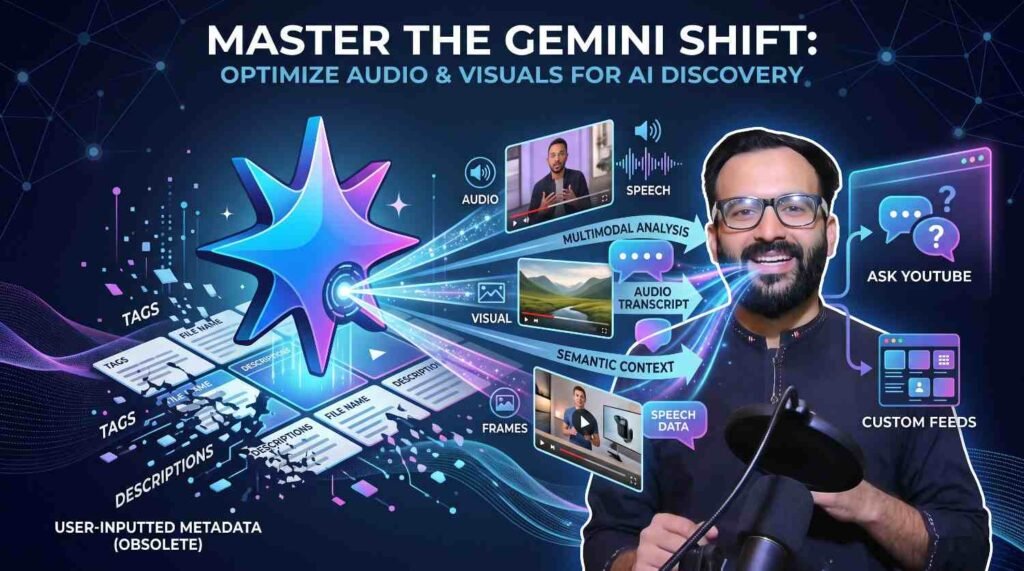
Manual metadata tactics—such as stuffing tags, hashtags, and keyword-heavy descriptions—no longer drive discovery on YouTube. The platform’s integration of Google’s Gemini AI into its core recommendation and search engines has fundamentally automated content indexing. Instead of relying on creator-provided labels, the algorithm now analyzes the actual audio transcript and visual frames of every video to generate its own semantic metadata. Adapting to this shift requires creators to optimize their spoken dialogue, visual context, and video segmentation for AI-driven discovery surfaces like Ask YouTube and Custom Feeds.
The Algorithmic Transformation: Automated Frame and Dialogue Analysis
Historically, YouTube depended on user-supplied metadata—titles, descriptions, tags, and file names—to evaluate topical relevance and target viewer groups. The integration of Gemini AI replaces this dependency with direct, deep-level content processing:
-
Frame-by-Frame Visual Auditing: Computer vision systems scan visual components inside the video to verify objects, demonstrations, and on-screen topics directly.
-
Autonomous Semantic Profiling: The algorithm cross-references spoken dialogue from the transcript with on-screen visual context to construct an independent metadata profile, bypassing manual tags entirely.
-
Diminished Utility of Metadata Stuffing: Repeatedly embedding identical target phrases into descriptions or tags yields minimal ranking utility, as the system measures true content delivery rather than surface-level claims.
AI-Native Discovery Features: Ask YouTube and Custom Feeds
The transition to generative search models has produced new distribution surfaces that bypass standard search query bars and traditional homepage algorithms:
-
Ask YouTube: A conversational, prompt-based discovery system. Viewers type detailed, natural-language questions rather than fragmented keywords. The engine identifies matching videos, Shorts, and specific, highlighted timestamps that directly address the user’s question.
-
Custom Feeds: An interface allowing viewers to define the exact content type, topical niche, or mood they want to watch. The system dynamically populates an entire feed matching that specific description rather than relying purely on past general watch history.
Five Core Optimization Practices for Modern YouTube SEO
To capture traffic from AI search features and personalized feeds, creators must align production techniques with semantic indexing:
-
Transition from Isolated Keywords to Full Topic Authority: Instead of building content around a single repeated keyword, structure videos to answer complete, nuanced subtopics and multi-layered viewer questions naturally.
-
Pronounce Explicit Entities in Spoken Dialogue: Because transcripts supply the core indexing context, explicitly state the exact names of products, places, tools, and concepts instead of using ambiguous references like “this,” “that,” or “it.”
-
Implement Descriptive, Specific Video Chapters: Discard generic labels such as “Tip 1,” “Method 2,” or “Step 3.” Use concise, 4-to-5-word descriptive chapter headings that specify the precise takeaway of the timestamp, enabling Ask YouTube to surface the exact segment.
-
Architect Content in Modular Segments: Plan and record each video with distinct, value-focused sections. Self-contained segments allow generative search tools to isolate a timestamped block and deliver it directly to a user whose query matches that specific portion.
-
Synchronize Dialogue with On-Screen Demonstration: Maintain direct visual alignment between what is spoken and what is displayed on screen. Visual and audible consistency ensures automated multimodal parsers extract clear, unified topical signals throughout the video.
Do tags still work on YouTube?
No, manual tags and keyword stuffing no longer drive discovery because the algorithm automatically indexes spoken dialogue and video frames using Gemini AI.
How does Gemini index YouTube videos?
Gemini analyzes the audio transcript alongside frame-by-frame visuals to build an autonomous, highly accurate semantic metadata profile for each video.
What is the Ask YouTube feature?
Ask YouTube is an AI-powered conversational search tool that answers detailed user prompts by highlighting exact timestamps and relevant video segments.
How should creators write video chapters?
Creators should replace generic labels with specific, descriptive chapter headings so search systems can surface relevant timestamps for matching queries.